CASE STUDY
SocialBoost Digital: Launch Fast, Learn Quickly
IMPACT
Achieved 90+ Performance Score on PageSpeed Insights
A full-service digital marketing agency website built to showcase branding, content creation, and SEO services with modern web technologies.
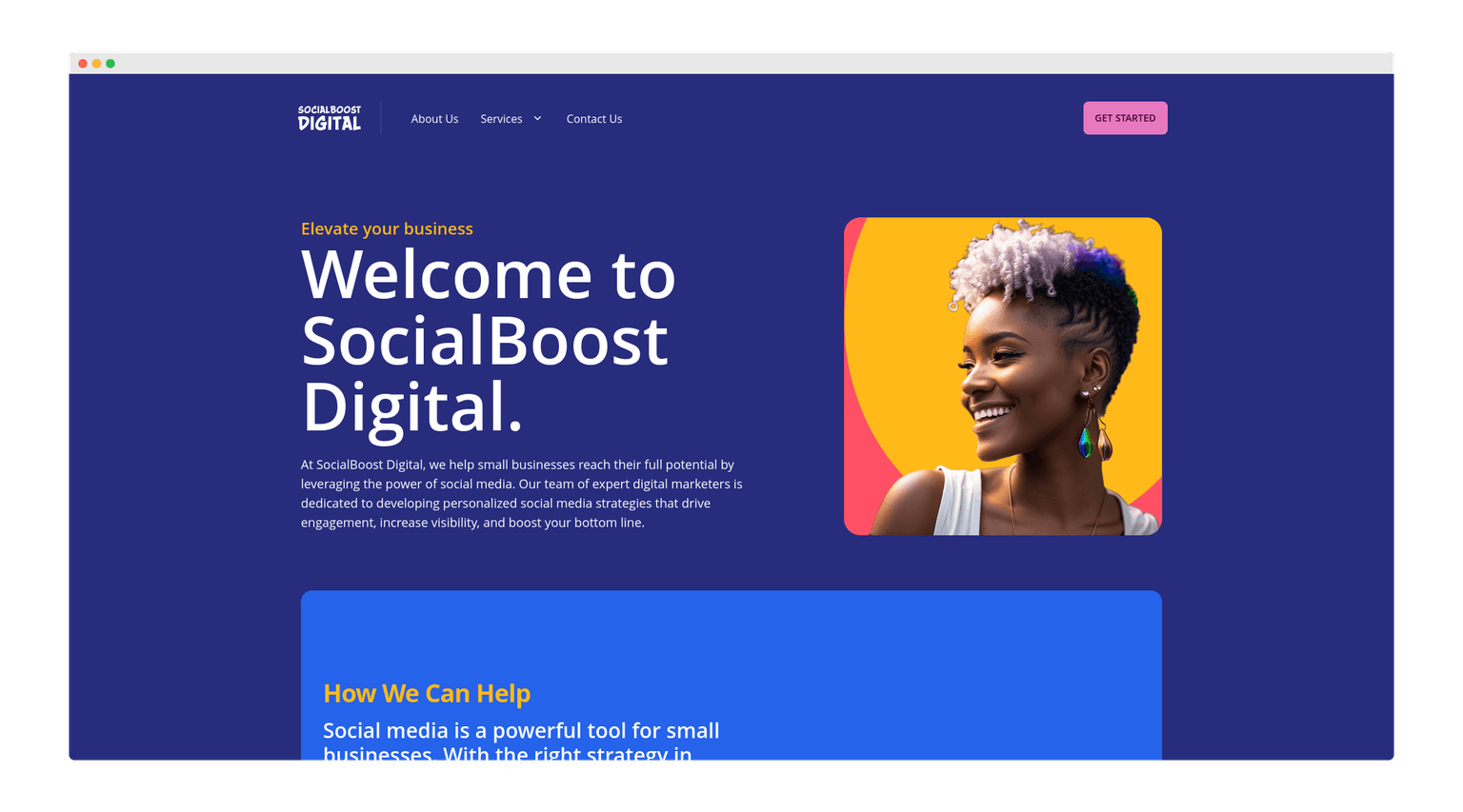
IMPACT AT A GLANCE
90+
PageSpeed
TIMELINE
Iterative development with weekly goals
ROLE
Full-stack developer
TEAM
Solo project
THE CHALLENGE
Balancing aesthetic design with performance optimization, managing static image rendering, maintaining content updates without hosting complications, and achieving high performance scores while preserving visual quality.
THE RESULTS
- Achieved 90+ Performance Score on PageSpeed Insights
- Optimized SEO, accessibility, and user experience
- Created a dynamic, evolving digital presence for the agency
- Delivered a scalable foundation for ongoing content updates
THE SOLUTION
Implemented Nuxt.js with Tailwind CSS and Daisy-UI components for efficient development. Leveraged Nuxt Content for effortless content management. Replaced Nuxt Image with standard HTML img elements to resolve static rendering issues. Adopted an iterative launch-fast, learn-quickly approach that prioritized shipping increments over perfectionism.
TECHNOLOGIES USED
- Nuxt.js
- Vue.js
- Tailwind CSS
- Daisy-UI
- Nuxt Content
- JAMstack
Project Details
What problem did this solve for a small marketing agency?
SocialBoost Digital needed a public site that could sell branding, content, and SEO services without feeling slow or hard to update. The brief mixed visual polish with a hard performance bar, and content had to stay editable without wrestling a traditional CMS host every week.
How was the site delivered?
The build used a JAMstack stack—Nuxt.js, Vue.js, Tailwind CSS, and Daisy-UI—so UI work stayed fast and consistent. Nuxt Content handled structured pages and copy updates. When Nuxt Image fought static asset rendering, switching to standard HTML img elements unblocked shipping while keeping visual quality intact.
What results did that cadence produce?
Weekly goals replaced a big-bang redesign. Each increment improved SEO, accessibility, and UX based on what the live site revealed. That cadence produced a 90+ PageSpeed Insights performance score and left a foundation the agency could keep evolving without a rewrite.
MORE WORK
OTHER CASE STUDIES

TrustClarity: Buyer Portal Rebuild — Search-First TC 2.0 Platform
IMPACT:
400+ Storybook stories across 130+ components (from 11), WCAG 2.1 AA remediation, RFQ flow with server-side credential fix, and 1,533 lines of storefront code removed for a search-first pivot
React/Next.js rebuild of TrustClarity's core buyer workflows — Figma-to-production, WCAG 2.1 AA, Storybook/Chromatic visual gates, and a search-first architecture that replaced the per-org storefront layer.

TrustClarity: Orchestrating Google Jules Multi-Agent Delivery on the Buyer Platform
IMPACT:
Four signed merges into develop covering AGENTS.md plus three UAT fixes; one additional thumbnail/search fix with a TypeScript no-suppression governance lesson; durable signed-commit / pull-and-re-PR playbook confirmed across later Jules rounds
Production orchestration of Google Jules on the TrustClarity buyer platform — first and second UAT rounds, signed-commit re-PR playbook, prompt discipline, and AGENTS.md governance that kept parallel cloud sessions safe to merge.

TrustClarity: Supply-Chain Security Analysis and CI/CD Hardening
IMPACT:
14 of 20 repositories remediated before TrustClarity production; 3 attack vectors eradicated; SHA-pinned reusable security-scan workflow rolled out to 20 repos; later SHA-pin and merge-base invisibility controls shipped
Org-wide supply-chain security analysis for TrustClarity — malicious code found in 14 of 20 repositories across three attack vectors, remediated in repos before it reached TrustClarity's own production environment, followed by a SHA-pinned reusable CI/CD security pipeline and later hardening controls.